Main menu

  • HOME
  • LATEST ARTICLES
  • ALL ISSUES
  • AUTHORS & REVIEWERS
  • RESOURCES
    • About BJGP Open
    • BJGP Open Accessibility Statement
    • Editorial Board
    • Editorial Fellowships
    • Audio Abstracts
    • eLetters
    • Alerts
    • BJGP Life
    • Research into Publication Science
    • Advertising
    • Contact
  • SPECIAL ISSUES
    • Social Care Integration with Primary Care: call for articles
    • Special issue: Telehealth
    • Special issue: Race and Racism in Primary Care
    • Special issue: COVID-19 and Primary Care
    • Past research calls
    • Top 10 Research Articles of the Year
  • BJGP CONFERENCE →
  • RCGP
    • British Journal of General Practice
    • BJGP for RCGP members
    • RCGP eLearning
    • InnovAIT Journal
    • Jobs and careers

User menu

  • Alerts

Search

  • Advanced search
Intended for Healthcare Professionals
BJGP Open
  • RCGP
    • British Journal of General Practice
    • BJGP for RCGP members
    • RCGP eLearning
    • InnovAIT Journal
    • Jobs and careers
  • Subscriptions
  • Alerts
  • Log in
  • Follow BJGP Open on Instagram
  • Visit bjgp open on Bluesky
  • Blog
Intended for Healthcare Professionals
BJGP Open

Advanced Search

  • HOME
  • LATEST ARTICLES
  • ALL ISSUES
  • AUTHORS & REVIEWERS
  • RESOURCES
    • About BJGP Open
    • BJGP Open Accessibility Statement
    • Editorial Board
    • Editorial Fellowships
    • Audio Abstracts
    • eLetters
    • Alerts
    • BJGP Life
    • Research into Publication Science
    • Advertising
    • Contact
  • SPECIAL ISSUES
    • Social Care Integration with Primary Care: call for articles
    • Special issue: Telehealth
    • Special issue: Race and Racism in Primary Care
    • Special issue: COVID-19 and Primary Care
    • Past research calls
    • Top 10 Research Articles of the Year
  • BJGP CONFERENCE →
Research

Excessive polypharmacy and potentially inappropriate prescribing in 147 care homes: a cross-sectional study

Clare MacRae, David AG Henderson, Stewart W Mercer, Jenni Burton, Nicosha De Souza, Paula Grill, Charis Marwick and Bruce Guthrie
BJGP Open 2021; 5 (6): BJGPO.2021.0167. DOI: https://doi.org/10.3399/BJGPO.2021.0167
Clare MacRae
Centre for Population Health Sciences, Usher Institute, University of Edinburgh, Edinburgh, UK 1
  • Find this author on Google Scholar
  • Find this author on PubMed
  • Search for this author on this site
David AG Henderson
Centre for Population Health Sciences, Usher Institute, University of Edinburgh, Edinburgh, UK 1
  • Find this author on Google Scholar
  • Find this author on PubMed
  • Search for this author on this site
  • For correspondence: David.Henderson{at}ed.ac.uk
Stewart W Mercer
Centre for Population Health Sciences, Usher Institute, University of Edinburgh, Edinburgh, UK 1
  • Find this author on Google Scholar
  • Find this author on PubMed
  • Search for this author on this site
Jenni Burton
2 Institute of Cardiovascular and Medical Sciences, University of Glasgow, Glasgow, UK
  • Find this author on Google Scholar
  • Find this author on PubMed
  • Search for this author on this site
Nicosha De Souza
3 Population Health and Genomics, School of Medicine, University of Dundee, Dundee, UK
  • Find this author on Google Scholar
  • Find this author on PubMed
  • Search for this author on this site
Paula Grill
3 Population Health and Genomics, School of Medicine, University of Dundee, Dundee, UK
  • Find this author on Google Scholar
  • Find this author on PubMed
  • Search for this author on this site
Charis Marwick
3 Population Health and Genomics, School of Medicine, University of Dundee, Dundee, UK
  • Find this author on Google Scholar
  • Find this author on PubMed
  • Search for this author on this site
Bruce Guthrie
Centre for Population Health Sciences, Usher Institute, University of Edinburgh, Edinburgh, UK 1
  • Find this author on Google Scholar
  • Find this author on PubMed
  • Search for this author on this site
  • Article
  • Figures & Data
  • Info
  • eLetters
  • PDF
Loading

Article Figures & Data

Figures

  • Tables
  • Multilevel logistic regression analysis of excessive polypharmacy in care home residents, adjusted model. RAD = Risk Assessment Document.
    • Download figure
    • Open in new tab
    • Download powerpoint
    Figure 1. Multilevel logistic regression analysis of excessive polypharmacy in care home residents, adjusted model. RAD = Risk Assessment Document.
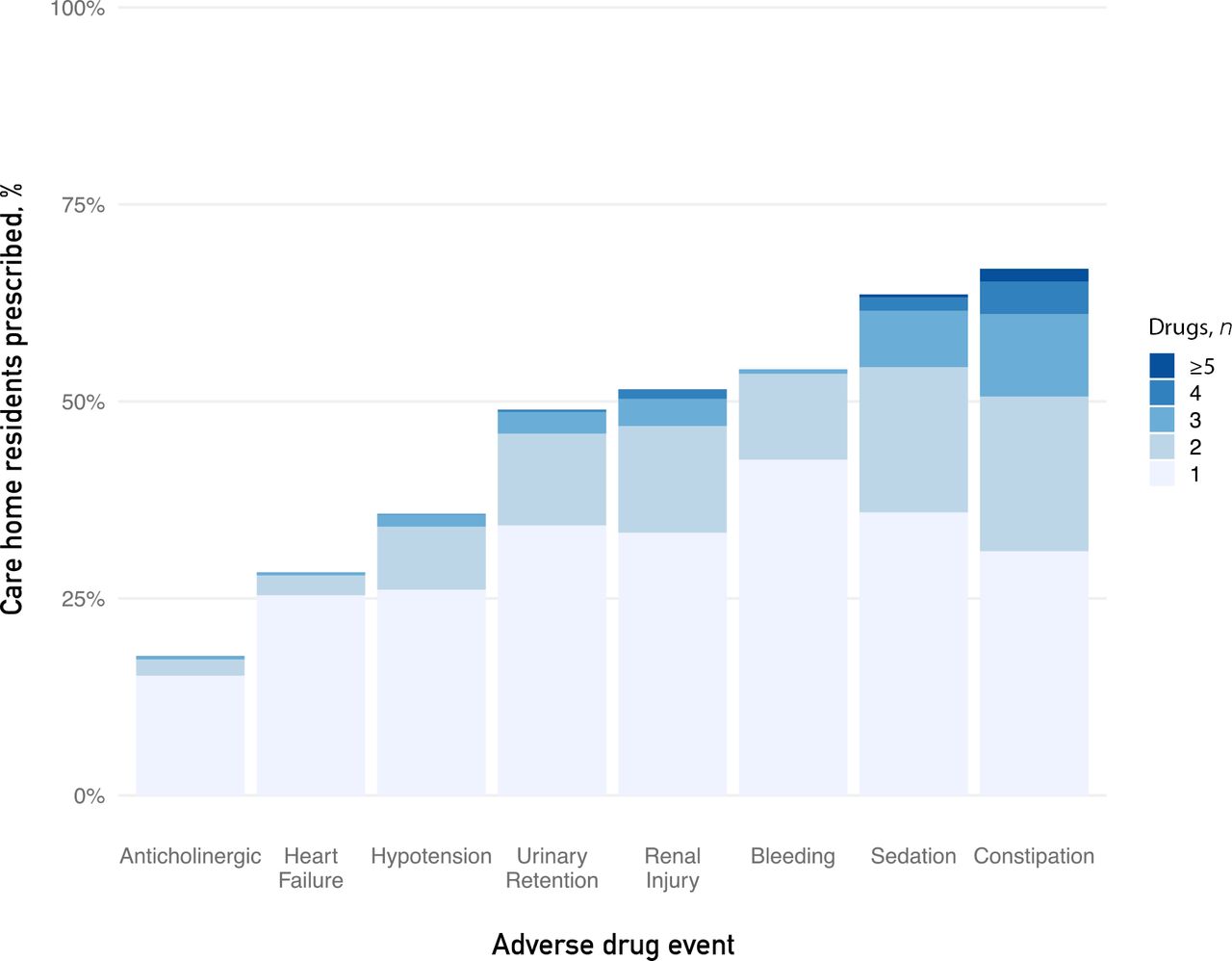
  • Percentage of care home residents prescribed drugs associated with eight common adverse drug events (ADEs)
    • Download figure
    • Open in new tab
    • Download powerpoint
    Figure 2. Percentage of care home residents prescribed drugs associated with eight common adverse drug events (ADEs)

Tables

  • Figures
    • View popup
    Table 1. Resident and care home characteristics
    CharacteristicCategoryDispensed 0–9 drugs,n = 3024, n (%)aDispensed ≥10 drugs,n = 1444, n (%)aAll residents,n = 4468, n (%)a
    SexMale850 (28.1)422 (29.2)1272 (28.5)
    Female2174 (71.9)1022 (70.8)3196 (71.5)
    Age, yearsMean (SD)85.1 (8.3)84.6 (7.9)84.9 (8.1)
    Age group, years60–6468 (2.2)19 (1.3)87 (1.9)
    65–69101 (3.3)53 (3.7)154 (3.4)
    70–74184 (6.1)101 (7.0)285 (6.4)
    75–79317 (10.5)163 (11.3)480 (10.7)
    80–84580 (19.2)302 (20.9)882 (19.7)
    85–89765 (25.3)393 (27.2)1158 (25.9)
    90–94709 (23.4)288 (19.9)997 (22.3)
    ≥95300 (9.9)125 (8.7)425 (9.5)
    Drugs prescribedb Mean (SD)——7.8 (4.3)
    Median (IQR)——8 (3–13)
    Number of BNF chapters drugs prescribed fromMean (SD)3.4 (1.5)6.1 (1.3)4.2 (1.9)
    Dementia diagnosisNo dementia1506 (49.8)802 (55.5)2308 (51.7)
    Dementia1518 (50.2)642 (44.5)2160 (48.3)
    Care home typeNursing care
    (n = 71 homes)
    1858 (61.4)743 (51.5)2601 (58.2)
    Residential care
    (n = 76 homes)
    1166 (38.6)701 (48.5)1867 (41.8)
    Service sectorPrivate (n = 117)2625 (86.8)1124 (77.8)3749 (83.9)
    Local Authority (n = 19)246 (8.1)205 (14.2)451 (10.1)
    Third sector (n = 11)153 (5.1)115 (8.0)268 (6.0)
    Care home sizec Small (n = 41)417 (13.8)220 (15.2)637 (14.3)
    Medium (n = 68)1314 (43.5)714 (49.4)2028 (45.4)
    Large (n = 37)1290 (42.7)510 (35.3)1800 (40.3)
    RAD scoreLow (n = 102)1994 (65.9)1045 (72.4)3039 (68.0)
    Medium (n = 19)421 (13.9)175 (12.1)596 (13.3)
    High (n = 26)609 (20.1)224 (15.5)833 (18.6)
    Health boardTayside (n = 90)1871 (61.9)805 (55.7)2676 (59.9)
    Fife (n = 57)1153 (38.1)639 (44.3)1792 (40.1)
    • aUnless otherwise stated. bDistribution normal overall but skewed in groups so SD and IRQ not reported for groups. Overall distribution shown in Supplementary Figure S1. cMissing data for one care home. BNF = British National Formulary. IQR = interquartile range. RAD = Risk Assessment Document. SD = standard deviation.

    • View popup
    Table 2. Number of care home residents, mean number of medicines, and most frequent drug class prescribed, by BNF chapter
    Most frequent drug class prescribed
    BNF chapterPatients prescribed medicine, n (%)Medications prescribed, mean (SD)First (%)
    Second (%)
    Third (%)
    Fourth (%)
    Fifth (%)
    1. Gastrointestinal System2991 (66.9)1.63 (0.84)Osmotic laxatives (36.3)Proton pump inhibitors(35.8)Stimulant laxatives (17.7)H2 receptor agonists (5.2)Compound alginates and proprietary antacids (3.9)
    2. Cardiovascular System2883 (64.5)2.32 (1.3)Statins (27.3)Loop diuretics (20.6)Aspirin (17.8)Beta-adrenoceptor blocking drugs (17.5)Clopidogrel (14.4)
    3. Respiratory System684 (15.3)1.79 (1.15)Short acting beta2 adrenoceptor agonists (6.1)Inhaled corticosteroids (5.6)Non-sedating antihistamines (4.9)Antimuscarinic bronchodilators (3.3)Sedating antihistamines (1.7)
    4. Central Nervous System3687 (82.5)2.39 (1.37)Paracetamol (47.2)Drugs for dementia (26.4)SSRI antidepressants (19.0)Other antidepressants (16.7)Opioid analgesics (16.3)
    5. Infections1402 (31.4)1.41 (0.74)Broad spectrum penicillins (11.4)Sulfonamides and trimethoprim (8.1)Nitrofurantoin (6.2)Penicillinase-resistant penicillins (4.2)Tetracyclines (4.1)
    6. Endocrine System1658 (37.1)1.26 (0.56)Thyroid hormones (19.2)Bisphosphonates and drugs affecting bone metabolism (10.1)Biguanides (5.3)Treatment corticosteroids (3.4)Male sex hormones and antagonists (3.3)
    7. Obstetrics, Gynaecology and Urinary-Tract Disorders404 (9.0)1.07 (0.27)Drugs for urinary frequency, enuresis, incontinence (5.3)Drugs for urinary retention (3.4)Vaginal and vulval infections (0.5)Topical hormone replacement therapy(0.4)Drugs used in urological pain (0.1)
    8. Malignant Disease and Immunosuppression83 (1.9)1 (0)Hormone antagonists (1.5)Azathioprine (0.2)Other antineoplastic (0.1)Mycophenolate (<0.1)Ciclosporin (<0.1)
    9. Nutrition and Blood2011 (45.0)1.98 (0.78)Vitamin D (35.6)Oral iron (10.2)Drugs used in megaloblastic anaemias (9.9)Fluoride (1.1)Calcium supplements (0.5)
    10. Musculoskeletal and Joint Diseases692 (15.5)1.09 (0.31)Rubefacients, topical NSAIDs, capsaicin, and poultices (11.7)Gout and cytotoxic induced hyperuricaemia (2.4)Skeletal muscle relaxants(1.5)Methotrexate (0.4)Nonselective NSAIDs (0.4)
    11. Eye595 (13.3)1.46 (0.82)Tear deficiency, ocular lubricants and astringents (7.6)Glaucoma: prostaglandinanalogues (3.8)Antibacterial eye preparations (2.2)Glaucoma: other (1.4)Glaucoma: beta-blockers (0.9)
    12. Ear, Nose and Oropharynx133 (3.0)1.06 (0.24)Nasal allergy, topical antihistamines and cromoglicate (1.6)Drugs for oral ulceration and inflammation (0.5)Otitis externa (0.3)Oropharyngeal anti-infective drugs (0.3)Topical nasal decongestants (0.2)
    13. Skin1747 (39.1)1.65 (0.97)Emollients (23.1)Barrier preparations (15.8)Topical corticosteroids (9.0)Antifungal skin preparations (2.6)Shampoos and other preparations for scalp and/or hair (1.7)
    • BNF = British National Formulary. SD = standard deviation. SSRI = selective-serotonin reuptake inhibitors. NSAIDs = non-steroidal anti-inflammatory drugs.

    • View popup
    Table 3. Multilevel logistic regression analysis of excessive polypharmacy in care home residents
    CharacteristicCategoryDispensed ≥10 drugs,n = 1444, n (%)OR univariable(95% CI)b,cOR multivariable(95% CI)c,d
    Age group, years60–6419 (21.8)RefRef
    65–6953 (34.4)1.76 (0.94 to 3.29)1.80 (0.96 to 3.38)
    70–74101 (35.4)1.79 (1.00 to 3.21)1.86 (1.04 to 3.34)
    75–79163 (34.0)1.67 (0.96 to 2.94)1.73 (0.98 to 3.03)
    80–84302 (34.2)1.65 (0.96 to 2.85)1.75 (1.01 to 3.02)
    85–89393 (33.9)1.60 (0.93 to 2.75)1.66 (0.97 to 2.87)
    90–94288 (28.9)1.18 (0.68 to 2.04)1.19 (0.69 to 2.07)
    ≥95125 (29.4)1.14 (0.64 to 2.01)1.08 (0.61 to 1.92)
    SexMale422 (33.2)Ref–
    Female1022 (32.0)0.89 (0.77 to 1.03)–
    Dementia statusNo dementia802 (34.7)RefRef
    Dementia642 (29.7)0.78 (0.68 to 0.89)0.73 (0.64 to 0.84)
    Care home typeNursing743 (28.6)RefRef
    Residential701 (37.5)1.49 (1.19 to 1.85)1.50 (1.19 to 1.88)
    RAD scoreLow1045 (34.4)RefRef
    Medium175 (29.4)0.75 (0.54 to 1.06)0.72 (0.52 to 0.99)
    High224 (26.9)0.69 (0.51 to 0.93)0.77 (0.56 to 1.04)
    NHS health boardTayside805 (30.1)RefRef
    Fife639 (35.7)1.24 (0.99 to 1.57)1.37 (1.09 to 1.71)
    Intraclass correlation coefficient, % (95% CI)——8.9 (5.9 to 11.6)Null model7.1 (4.2 to 9.5)Adjusted model
    • aWithin category %. bNumber of groups = 147; residents in all models = 4468. Service sector and care home size not fitted in models as collinear with care home status. cUnless otherwise stated. dC-statistic = 0.685. – = variable not fitted. RAD = Risk Assessment Document.

Supplementary Data

  • McR_BJGPO.2021.0167_Supp.pdf -

    Supplementary material is not copyedited or typeset, and is published as supplied by the author(s). The author(s) retain(s) responsibility for its accuracy.

Back to top
Previous ArticleNext Article

In this issue

BJGP Open
Vol. 5, Issue 6
January 2021
  • Table of Contents
  • Index by author
Download PDF
Download PowerPoint
Email Article

Thank you for recommending BJGP Open.

NOTE: We only request your email address so that the person to whom you are recommending the page knows that you wanted them to see it, and that it is not junk mail. We do not capture any email address.

Enter multiple addresses on separate lines or separate them with commas.
Excessive polypharmacy and potentially inappropriate prescribing in 147 care homes: a cross-sectional study
(Your Name) has forwarded a page to you from BJGP Open
(Your Name) thought you would like to see this page from BJGP Open.
CAPTCHA
This question is for testing whether or not you are a human visitor and to prevent automated spam submissions.
Citation Tools
Excessive polypharmacy and potentially inappropriate prescribing in 147 care homes: a cross-sectional study
Clare MacRae, David AG Henderson, Stewart W Mercer, Jenni Burton, Nicosha De Souza, Paula Grill, Charis Marwick, Bruce Guthrie
BJGP Open 2021; 5 (6): BJGPO.2021.0167. DOI: 10.3399/BJGPO.2021.0167

Citation Manager Formats

  • BibTeX
  • Bookends
  • EasyBib
  • EndNote (tagged)
  • EndNote 8 (xml)
  • Medlars
  • Mendeley
  • Papers
  • RefWorks Tagged
  • Ref Manager
  • RIS
  • Zotero
Share
Excessive polypharmacy and potentially inappropriate prescribing in 147 care homes: a cross-sectional study
Clare MacRae, David AG Henderson, Stewart W Mercer, Jenni Burton, Nicosha De Souza, Paula Grill, Charis Marwick, Bruce Guthrie
BJGP Open 2021; 5 (6): BJGPO.2021.0167. DOI: 10.3399/BJGPO.2021.0167
del.icio.us logo Facebook logo Mendeley logo Bluesky logo
  • Tweet Widget
  • LinkedIn logo LinkedIn
  • Mendeley logo Mendeley
  • Bluesky logo Bluesky

Jump to section

  • Top
  • Article
    • Abstract
    • How this fits in
    • Introduction
    • Method
    • Results
    • Discussion
    • Notes
    • References
  • Figures & Data
  • Info
  • eLetters
  • PDF

Keywords

  • general practice
  • Polypharmacy
  • prescribing safety
  • care homes
  • older people
  • drug-related side effects and adverse reactions

More in this TOC Section

  • General practitioners’ perspectives on implementing a self-management mobile application for musculoskeletal pain
  • Checklists for emergencies in general practice: participatory design of a quick reference handbook
  • Exploring the coding of migration status in English primary care from 2011–2025 using OpenCodeCounts: a descriptive study
Show more Research

Related Articles

Cited By...

Intended for Healthcare Professionals


British Journal of General Practice

NAVIGATE

  • Home
  • Latest articles
  • Authors & reviewers
  • Accessibility statement

RCGP

  • British Journal of General Practice
  • BJGP for RCGP members
  • RCGP eLearning
  • InnovAiT Journal
  • Jobs and careers

MY ACCOUNT

  • RCGP members' login
  • Terms and conditions

NEWS AND UPDATES

  • About BJGP Open
  • Alerts
  • RSS feeds
  • Facebook
  • Twitter

AUTHORS & REVIEWERS

  • Submit an article
  • Writing for BJGP Open: research
  • Writing for BJGP Open: practice & policy
  • BJGP Open editorial process & policies
  • BJGP Open ethical guidelines
  • Peer review for BJGP Open

CUSTOMER SERVICES

  • Advertising
  • Open access licence

CONTRIBUTE

  • BJGP Life
  • eLetters
  • Feedback

CONTACT US

BJGP Open Journal Office
RCGP
30 Euston Square
London NW1 2FB
Tel: +44 (0)20 3188 7400
Email: bjgpopen@rcgp.org.uk

BJGP Open is an editorially-independent publication of the Royal College of General Practitioners

© 2026 BJGP Open

Online ISSN: 2398-3795