Main menu

  • HOME
  • LATEST ARTICLES
  • ALL ISSUES
  • AUTHORS & REVIEWERS
  • RESOURCES
    • About BJGP Open
    • BJGP Open Accessibility Statement
    • Editorial Board
    • Editorial Fellowships
    • Audio Abstracts
    • eLetters
    • Alerts
    • BJGP Life
    • Research into Publication Science
    • Advertising
    • Contact
  • SPECIAL ISSUES
    • Social Care Integration with Primary Care: call for articles
    • Special issue: Telehealth
    • Special issue: Race and Racism in Primary Care
    • Special issue: COVID-19 and Primary Care
    • Past research calls
    • Top 10 Research Articles of the Year
  • BJGP CONFERENCE →
  • RCGP
    • British Journal of General Practice
    • BJGP for RCGP members
    • RCGP eLearning
    • InnovAIT Journal
    • Jobs and careers

User menu

  • Alerts

Search

  • Advanced search
Intended for Healthcare Professionals
BJGP Open
  • RCGP
    • British Journal of General Practice
    • BJGP for RCGP members
    • RCGP eLearning
    • InnovAIT Journal
    • Jobs and careers
  • Subscriptions
  • Alerts
  • Log in
  • Follow BJGP Open on Instagram
  • Visit bjgp open on Bluesky
  • Blog
Intended for Healthcare Professionals
BJGP Open

Advanced Search

  • HOME
  • LATEST ARTICLES
  • ALL ISSUES
  • AUTHORS & REVIEWERS
  • RESOURCES
    • About BJGP Open
    • BJGP Open Accessibility Statement
    • Editorial Board
    • Editorial Fellowships
    • Audio Abstracts
    • eLetters
    • Alerts
    • BJGP Life
    • Research into Publication Science
    • Advertising
    • Contact
  • SPECIAL ISSUES
    • Social Care Integration with Primary Care: call for articles
    • Special issue: Telehealth
    • Special issue: Race and Racism in Primary Care
    • Special issue: COVID-19 and Primary Care
    • Past research calls
    • Top 10 Research Articles of the Year
  • BJGP CONFERENCE →
Research

Discontinuation of a randomised controlled trial in general practice due to unsuccessful patient recruitment

Wendelien H van der Gaag, Roxanne van den Berg, Bart W Koes, Arthur M Bohnen, Lonny MG Hazen, Wilco C Peul, Leen Voogt, Arianne P Verhagen, Sita MA Bierma-Zeinstra and Pim AJ Luijsterburg
BJGP Open 2017; 1 (3): bjgpopen17X101085. DOI: https://doi.org/10.3399/bjgpopen17X101085
Wendelien H van der Gaag
1 GP trainee and PhD student, Department of General Practice, Erasmus MC, University Medical Center, , The Netherlands
MD
  • Find this author on Google Scholar
  • Find this author on PubMed
  • Search for this author on this site
  • For correspondence: w.vandergaag{at}erasmusmc.nl
Roxanne van den Berg
2 GP trainee and PhD student, Department of General Practice, Erasmus MC, University Medical Center, , The Netherlands
MD
  • Find this author on Google Scholar
  • Find this author on PubMed
  • Search for this author on this site
Bart W Koes
3 Professor of General Practice, Department of General Practice, Erasmus MC, University Medical Center, , The Netherlands
PhD
  • Find this author on Google Scholar
  • Find this author on PubMed
  • Search for this author on this site
Arthur M Bohnen
4 GP, Department of General Practice, Erasmus MC, University Medical Center, , The Netherlands
MD, PhD
  • Find this author on Google Scholar
  • Find this author on PubMed
  • Search for this author on this site
Lonny MG Hazen
5 GP, Department of General Practice, Erasmus MC, University Medical Center, , The Netherlands
MD
  • Find this author on Google Scholar
  • Find this author on PubMed
  • Search for this author on this site
Wilco C Peul
6 Professor of Neurosurgery, Department of Neurosurgery, Leiden University Medical Center, , The Netherlands
MD, PhD
  • Find this author on Google Scholar
  • Find this author on PubMed
  • Search for this author on this site
Leen Voogt
7 Patient and Board Member of 'De Wervelkolom', Dutch Association for Back Pain Patients, , The Netherlands
  • Find this author on Google Scholar
  • Find this author on PubMed
  • Search for this author on this site
Arianne P Verhagen
8 Associate Professor, Department of General Practice, Erasmus MC, University Medical Center, , The Netherlands
PhD
  • Find this author on Google Scholar
  • Find this author on PubMed
  • Search for this author on this site
Sita MA Bierma-Zeinstra
9 Professor of Osteoarthritis and Related Disorders, Departments of General Practice and Orthopedics, Erasmus MC, University Medical Center, , The Netherlands
PhD
  • Find this author on Google Scholar
  • Find this author on PubMed
  • Search for this author on this site
Pim AJ Luijsterburg
10 Assistant Professor, Department of General Practice, Erasmus MC, University Medical Center, , The Netherlands
PhD
  • Find this author on Google Scholar
  • Find this author on PubMed
  • Search for this author on this site
  • Article
  • Figures & Data
  • Info
  • eLetters
  • PDF
Loading

Article Figures & Data

Figures

  • Tables
  • Flow diagram of the STEP-UP trial (pragmatic design RCT).
    • Download figure
    • Open in new tab
    • Download powerpoint
    Figure 1. Flow diagram of the STEP-UP trial (pragmatic design RCT).
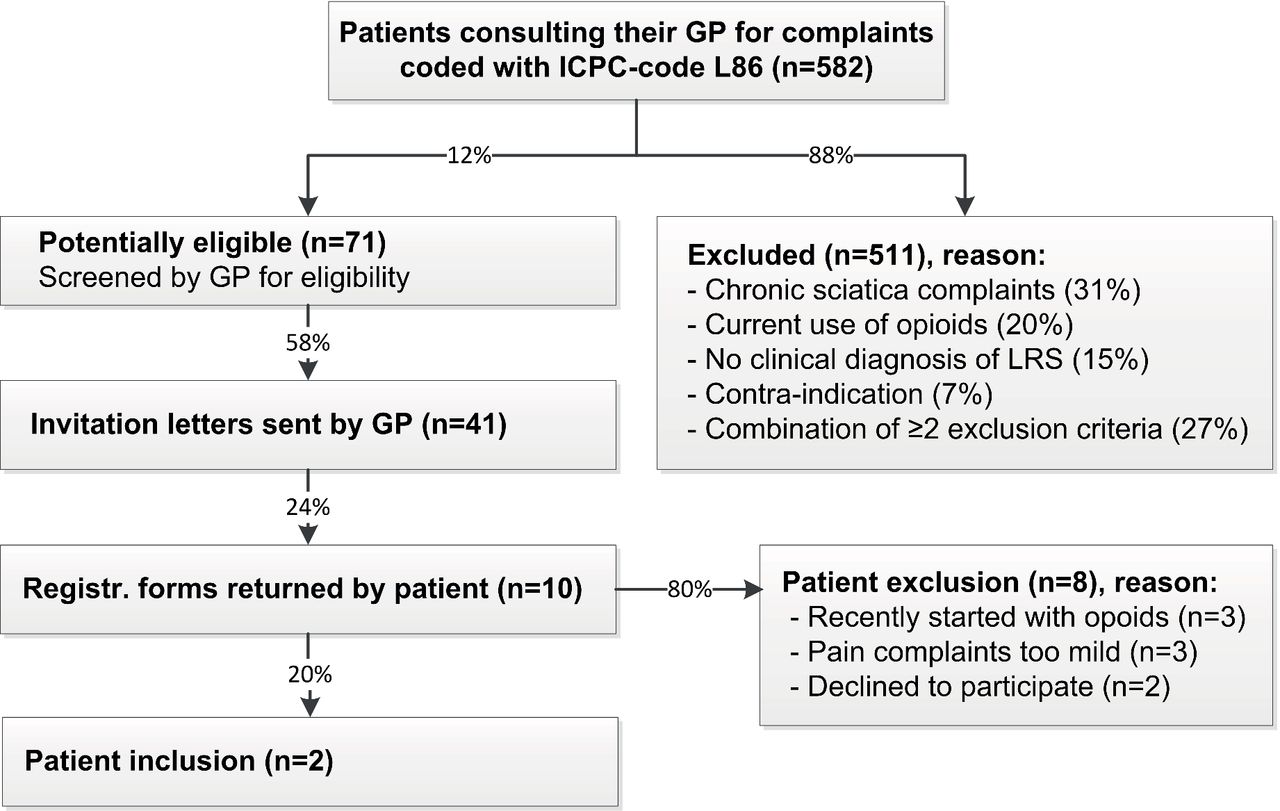
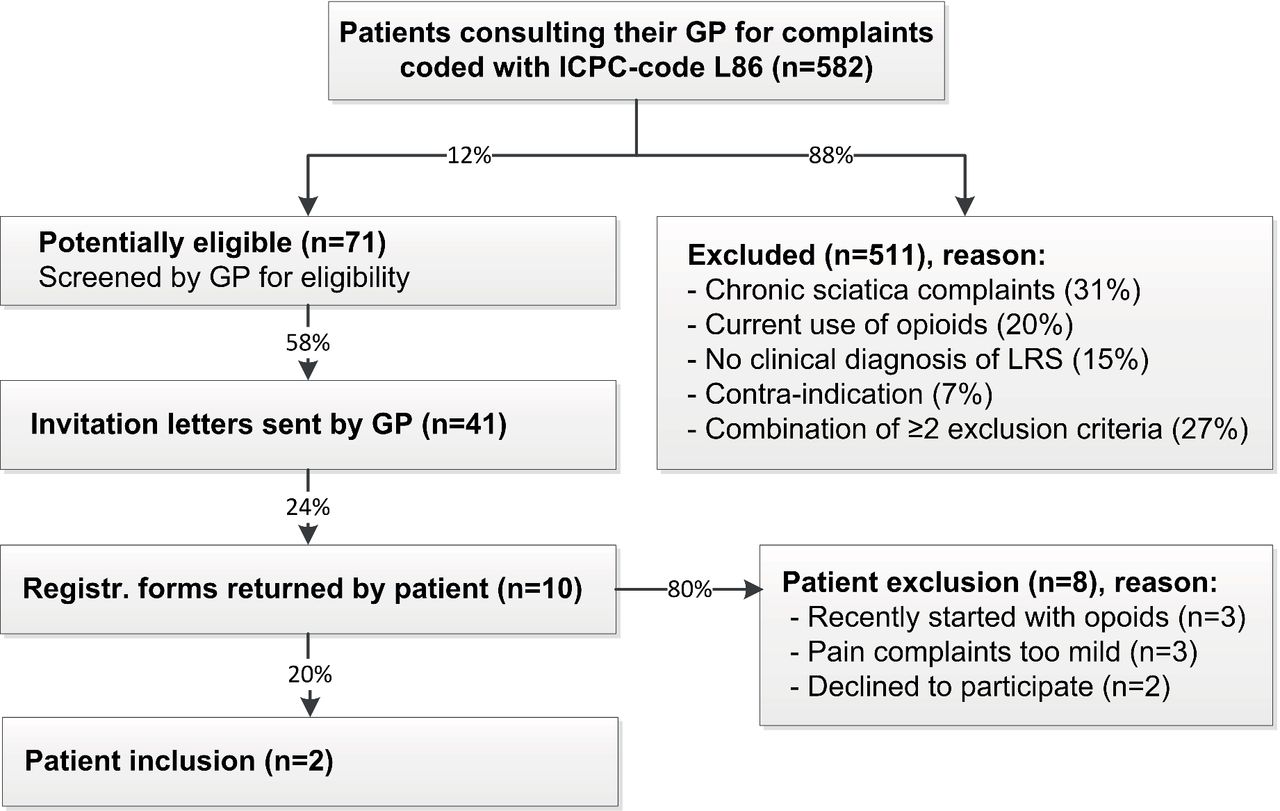
  • Systematic screening of GP information systems during a 3.5-month period. LRS = lumbosacral radicular syndrome.
    • Download figure
    • Open in new tab
    • Download powerpoint
    Figure 2. Systematic screening of GP information systems during a 3.5-month period. LRS = lumbosacral radicular syndrome.
Tables

  • Figures
    • View popup
    Box 1. STEP-UP trial design
    DesignA pragmatic, multicentre, open-label, randomised controlled trial with parallel group design, in general practices with a 3-month follow-up period
    SettingGeneral practices in the southwestern area of the Netherlands
    ObjectiveTo assess the clinical and cost-effectiveness of two pain medication prescription strategies in general practice over a 12-week period
    Eligibility criteriaInclusion criteria

    1. Age 18–65 years

    2. No use of opioids

    3. Radiating (pain) complaints in one leg below the knee

    4. Severity of radiating leg pain scored ≥7 on an 11-point numerical rating scale (0 = ‘no pain’; 10 = ‘worst pain imaginable’)

    5. Duration of the (pain) complaints <12 weeks

    6. Presence of at least one of the following symptoms:

      1. More pain on coughing, sneezing, or straining

      2. Decreased muscle strength in the leg

      3. Sensory deficits in the leg

      4. Decreased reflex activity in the leg

      5. Positive straight leg raising test

    Exclusion criteria

    1. An episode of radiating (pain) complaints in the preceding 6 months

    2. Back surgery in the past 3 years

    3. Treated with epidural injections

    4. Pregnancy

    5. Comorbidity that primary determines overall wellbeing (for example, an osteoporotic fracture, malignity, herpes zoster, or Lyme’s disease)

    6. Hypersensitivity to paracetamol, NSAID, or opioids

    7. Previous or active peptic ulcer

    8. Direct indication for surgery (fast progression of paresis of cauda equine syndrome)

    9. History of substance addiction or abuse

    OutcomePrimary outcome was the severity of radiating leg pain measured daily over a 6-week follow-up period using an 11-point numerical rating scale (score range 0–10), with a higher score indicating more pain.
    • View popup
    Table 1. Summary of responses of 22/116 (19%) GPs
    Reasons for insufficient recruitmentGPs: n (%)a
    Shared decision-making process: (strong) patient preference and/or GP preference for specific medication, diagnostics, randomisation outcome11 (50)
    Low incidence rate6 (27)
    Restrictive eligibility criteria6 (27)
    Priority setting: too many other responsibilities/administrative burden, time consuming/time pressure6 (27)
    No further delay wished5 (23)
    Forgetfulness5 (23)
    Lack of motivation4 (18)
    Other reasons4 (18)
    • aMore than one answer was possible.

    • View popup
    Box 2. Responses of 22/116 (19%) GPs suggested reasons for insufficient recruitment
    NumberWritten responses of the 22 GPsSummary of reasons
    1
    • Lack of patients who fulfilled eligibility criteria.

    • Most patients that considered participation didn’t want to use morphine.

    • A few patients with a language barrier or contra-indication for the use of either morphine or NSAIDs.

    • If, after this, patients could still be included, it was hard to include them and was too demanding in time and effort from the GP.

    • As a GP I am already used to prescribe morphine in case of severe pain.

    • In the trial design phase these problems were mentioned by GPs; for example in the GP network meeting, but I have the feeling this wasn’t taken into account enough.

    • Eligibility criteria

    • Shared decision making

    • Priority setting

    • Other

    2The threshold for patients (and doctor) is (too) high when it comes to prescribing morphine for pain relief. It takes a lot of effort from us as GPs to use diagnostics and titrate patients to morphine: usually this takes 1–2 patient contacts a week. A referral to the neurologist is faster. The low response is a pity: in my opinion it is a very relevant research question.
    • Shared decision making

    • Priority setting

    3My suspicion is that the researchers overestimated the incidence from ICPC L86. Maybe GPs encode inaccurately. Speaking for myself: when in doubt, if I can choose between L02, L03 or L86, I prefer L03 or L02. L86 seems to have much more consequences; as a GP I prefer some supporting diagnostics to code L86 with certainty. I consider the physical examination alone too limited to do so.
    • Incidence

    4
    • It is hard to remember the trial at the right moment.

    • What would help? A financial reward for the GP for admitting a patient to the trial. It’s a pity, but that is the case. With €50 per patient you would see an increase in trial participants.

    • Forgetfulness

    • Motivation

    5
    • Low amount of eligible patients.

    • Because of this, I don’t think about including a patient in the trial at the right moment; I forget it.

    • Eligibility criteria

    • Forgetfulness

    6When the trial was presented, we thought the research question to be very relevant. From the start of the trial I realised I found it hard to leave the choice for pain medication out of hands. In two cases with approximately the same amount of pain, you still choose a different pain management method per patient, depending on many other factors than just the pain. I didn’t want ‘the randomisation’ to decide this. But it’s a pity that this means we will not have an answer to the research question.
    • Shared decision making

    7It is difficult to ask a patient to participate in research before starting an intervention (for example, start of medication). So in this case it also didn’t help to select patients later with the screening, most of them were already using medication. And for ... research: the GP ‘just’ forgets about it. The GP assistant is the first contact moment with the patient; it would already help if they ... put a note in the patient's file about the possibility of participating in the trial.
    • Shared decision making

    • Delay

    • Forgetfulness

    8Too many research projects at the same time!
    • Motivation

    • Priority setting

    9
    • Low incidence of the disease. In 12 months I didn’t see any new patient with sciatica.

    • Not enough time in daily practice for informed consent.

    • For screening the patient information system for prevalent cases there is no binding contract concerning patient privacy for the research assistant.

    • Incidence

    • Priority setting

    • Other

    10
    • Research topic not that interesting.

    • Opioid pain medication often has a lot of side effects that are often underestimated. They made a phrase for this for a reason: opioid rotation. Well, and then a lot of patients die after a little while.

    • Low frequency of patients with sciatica.

    • Too many research projects.

    • Incidence

    • Shared decision making

    • Motivation

    • Priority setting

    11
    • Probably less ‘feeling’ with the research question.

    • I had the experience that a patient I submitted was excluded for the trial.

    • Patients often didn’t want to participate.

    • Later in the trial I lost my motivation.

    • Shared decision making

    • Motivation

    12
    • The pain score threshold for inclusion in the trial was very high (inherent to the possibility of opioid medication as painkillers): that is just quite rare.

    • And secondly: in such pain, patients have often already tried a lot of pain medication themselves, which makes participation in a trial and randomisation to the control arm feel like starting over with something you already knew it didn’t help.

    • Shared decision making

    • Eligibility criteria

    13The trial concerns a group of patients that demands and needs direct help. The research setting then causes an unnecessary and unwelcome delay.
    • Shared decision making

    • Delay

    14Incidence of the disease in general practice is too low.
    • Incidence

    15
    • Forgetfulness about the study before inclusion.

    • Our general practice joined the trial in January 2016 only.

    • The inclusion criteria were very specific and narrow; especially concerning the pain score.

    • Eligibility criteria

    • Forgetfulness

    • Other

    16
    • Sciatica is apparently less prevalent than expected.

    • Or maybe patients go to the physiotherapist by themselves and they don’t visit their GP anymore for this complaint? [Note: since 2005 a GP referral is no longer needed to consult a physiotherapist; everyone in the Netherlands is allowed direct access]

    • Incidence

    • Other

    17Very limited number of patients that presented themselves for consultation with sciatica complaints; and then additionally were also eligible for participation in the trial.
    • Incidence

    • Eligibility criteria

    18Attention in our general practice is mostly claimed by countless organisational tasks and duties like accreditation, new legislations (recently two new laws) and so on. We can’t handle more than sporadic and ad hoc duties.
    • Priority setting

    19
    • These are often patients with impatience, demanding a quick solution. As a GP you want to take away the agitation (and sometimes the 'demanding' behaviour) and quickly offer a bit of relief and structure through explanation and medication. The procedure through trial participation is too exhaustive.

    • As a GP, I don’t want 'this' patient to be randomised in the control arm; because I already changed my prescribing patterns a few years ago, so the treatment arm is how I currently treat my patients.

    • Shared decision making

    • Delay

    20In the acute phase you already act on your findings; so if morphine is needed, you have already prescribed this before the trial comes into focus.
    • Delay

    21
    • This is a proactive study, therefore I have to remember it at the moment itself.

    • Usually the treatment of choice is the result of a — sort of — negotiation between patient and GP.

    • Often patients already used paracetamol, or react like: 'Paracetamol?', and they feel unheard.

    • Shared decision making

    • Forgetfulness

    22
    • Myths about opioids by patients.

    • Patients want to start with medication directly.

    • In our general practice there’s often a language barrier which increases difficulty when it comes to explaining the trial and answering questionnaires.

    • Shared decision making

    • Eligibility criteria

    • Delay

Back to top
Previous ArticleNext Article

In this issue

BJGP Open
Vol. 1, Issue 3
October 2017
  • Table of Contents
  • Index by author
Download PDF
Download PowerPoint
Email Article

Thank you for recommending BJGP Open.

NOTE: We only request your email address so that the person to whom you are recommending the page knows that you wanted them to see it, and that it is not junk mail. We do not capture any email address.

Enter multiple addresses on separate lines or separate them with commas.
Discontinuation of a randomised controlled trial in general practice due to unsuccessful patient recruitment
(Your Name) has forwarded a page to you from BJGP Open
(Your Name) thought you would like to see this page from BJGP Open.
CAPTCHA
This question is for testing whether or not you are a human visitor and to prevent automated spam submissions.
Citation Tools
Discontinuation of a randomised controlled trial in general practice due to unsuccessful patient recruitment
Wendelien H van der Gaag, Roxanne van den Berg, Bart W Koes, Arthur M Bohnen, Lonny MG Hazen, Wilco C Peul, Leen Voogt, Arianne P Verhagen, Sita MA Bierma-Zeinstra, Pim AJ Luijsterburg
BJGP Open 2017; 1 (3): bjgpopen17X101085. DOI: 10.3399/bjgpopen17X101085

Citation Manager Formats

  • BibTeX
  • Bookends
  • EasyBib
  • EndNote (tagged)
  • EndNote 8 (xml)
  • Medlars
  • Mendeley
  • Papers
  • RefWorks Tagged
  • Ref Manager
  • RIS
  • Zotero
Share
Discontinuation of a randomised controlled trial in general practice due to unsuccessful patient recruitment
Wendelien H van der Gaag, Roxanne van den Berg, Bart W Koes, Arthur M Bohnen, Lonny MG Hazen, Wilco C Peul, Leen Voogt, Arianne P Verhagen, Sita MA Bierma-Zeinstra, Pim AJ Luijsterburg
BJGP Open 2017; 1 (3): bjgpopen17X101085. DOI: 10.3399/bjgpopen17X101085
del.icio.us logo Facebook logo Mendeley logo Bluesky logo
  • Tweet Widget
  • LinkedIn logo LinkedIn
  • Mendeley logo Mendeley
  • Bluesky logo Bluesky

Jump to section

  • Top
  • Article
    • Abstract
    • How this fits in
    • Introduction
    • Method
    • Results
    • Discussion
    • Notes
    • References
  • Figures & Data
  • Info
  • eLetters
  • PDF

Keywords

  • primary health care
  • general practice
  • Randomized Controlled Trial
  • patient recruitment
  • early termination of clinical trials
  • study design

More in this TOC Section

  • General practitioners’ perspectives on implementing a self-management mobile application for musculoskeletal pain
  • Checklists for emergencies in general practice: participatory design of a quick reference handbook
  • Exploring the coding of migration status in English primary care from 2011–2025 using OpenCodeCounts: a descriptive study
Show more Research

Related Articles

Cited By...

Intended for Healthcare Professionals


British Journal of General Practice

NAVIGATE

  • Home
  • Latest articles
  • Authors & reviewers
  • Accessibility statement

RCGP

  • British Journal of General Practice
  • BJGP for RCGP members
  • RCGP eLearning
  • InnovAiT Journal
  • Jobs and careers

MY ACCOUNT

  • RCGP members' login
  • Terms and conditions

NEWS AND UPDATES

  • About BJGP Open
  • Alerts
  • RSS feeds
  • Facebook
  • Twitter

AUTHORS & REVIEWERS

  • Submit an article
  • Writing for BJGP Open: research
  • Writing for BJGP Open: practice & policy
  • BJGP Open editorial process & policies
  • BJGP Open ethical guidelines
  • Peer review for BJGP Open

CUSTOMER SERVICES

  • Advertising
  • Open access licence

CONTRIBUTE

  • BJGP Life
  • eLetters
  • Feedback

CONTACT US

BJGP Open Journal Office
RCGP
30 Euston Square
London NW1 2FB
Tel: +44 (0)20 3188 7400
Email: bjgpopen@rcgp.org.uk

BJGP Open is an editorially-independent publication of the Royal College of General Practitioners

© 2026 BJGP Open

Online ISSN: 2398-3795